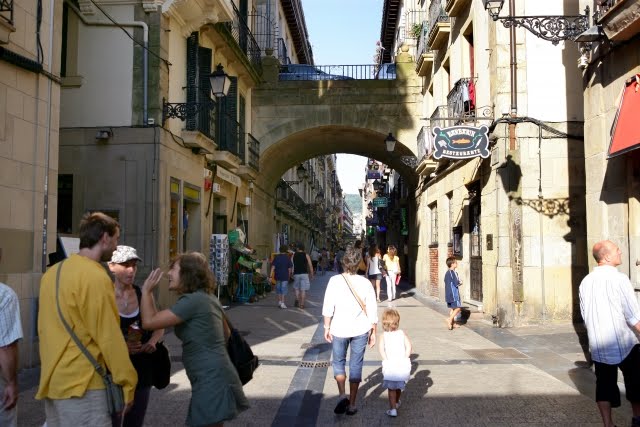
Café in the Gros district of San Sebastian
Just to make things clear: San Sebastian is not in Aquitaine. It is very close though, go on for fifteen minutes once you cross the border and here you are, saying Hola and Gracias (most of my Spanish vocabulary right there) and experiencing a completely different culture. You are in the north of Spain, in the Spanish Pays Basque.
Why do some places get it all? To define what San Sebastian is all about, imagine first that you take the most beautiful and spectacular place by the sea, two bays surrounded by hills and with the hazy mountains further away. The main beach La Concha is simply spectacular. That place in the sun leaves me speechless....
The Victoria Eugenia theatre
Then add the most beautiful 18th century architecture, blending ashlar fronts with ornated balconies and stonelaid pedestrian paths. Then you mix with a happy outgoing people that talk too loud and love being out in the bars and you get a glimpse of what San Sebastian is like. If that wasn't enough, let me also add that San Sebastian is the city with the highest Michelin star ratio per person in the world. You can't walk into a bar without admiring a long line of plates with little
pintxos (like tapas but here they are called pintxos).
I found an article in The Guardian (
Is San Sebastian the best place to eat in Europe?) that perfecly reflects my feelings about San Sebastian and its cuisine - part of the basque culture. Fresh, natural ingredients prepared with an high degree of perfectionism, yet simple and direct. And like he says in the article, you get good food wherever you go...
Pintxos
When you come into a bar, the cold pintxos are displayed on the counter. Order something to drink, then take a plate and serve yourself a few of them. When you leave, the waiter will ask you about how many you took - and the worst thing to do ever is to lie. Don't forget that most bars also serve hot pintxos, that they make to order. The old part of San Sebastian, Parte Viejo, overflows with bars....
My photos are taken during different times of the day, from full sunlight to the last rays of sun and also with an overcast sky... I didn't get at chance to take any good daytime photos from the main beach La Concha.... so I guess I have to go back!? Poor me. It takes a whole hour to go there.
Beach Zurriola, the surfers place, at daytime.
Zurriola at the end of the day. See that surfer with his board?
Café by the Zurriola beach in the last rays of sun. Behind you see the congress building Kursaal.
The Kursaal seen from the other side. The green and white columns are lamps on the Zurriola bridge across the river Urumea. At night, they and the Kursaal are lit up with a soft light. People walk and bike along the river and the sea.
The five star Maria Cristina hotel by the river Urumea. Created by the Spanish queen in 1912.
Details from a statue at the Maria Cristina bridge
The old part of San Sebastian, Parte Viejo, where you find small shops, restaurants and, more than in any other place that I know of, lots and lots of bars.
Plaza de Constitucion in the Parte Viejo
A small harbour at the foot of Mount Urgull.
Detail from the Ayuntamiento building
Approaching the Concha bay with gardens and palm trees
Very last rays of sun by the Concha bay at low tide
Further to the right of the Concha bay
Diputacion Foral and the sumptuous garden of the Plaza de Gipuzkoa
The Concha bay seen from the Mount Igeldo. Please click on the picture! Photo
Wikipedia.
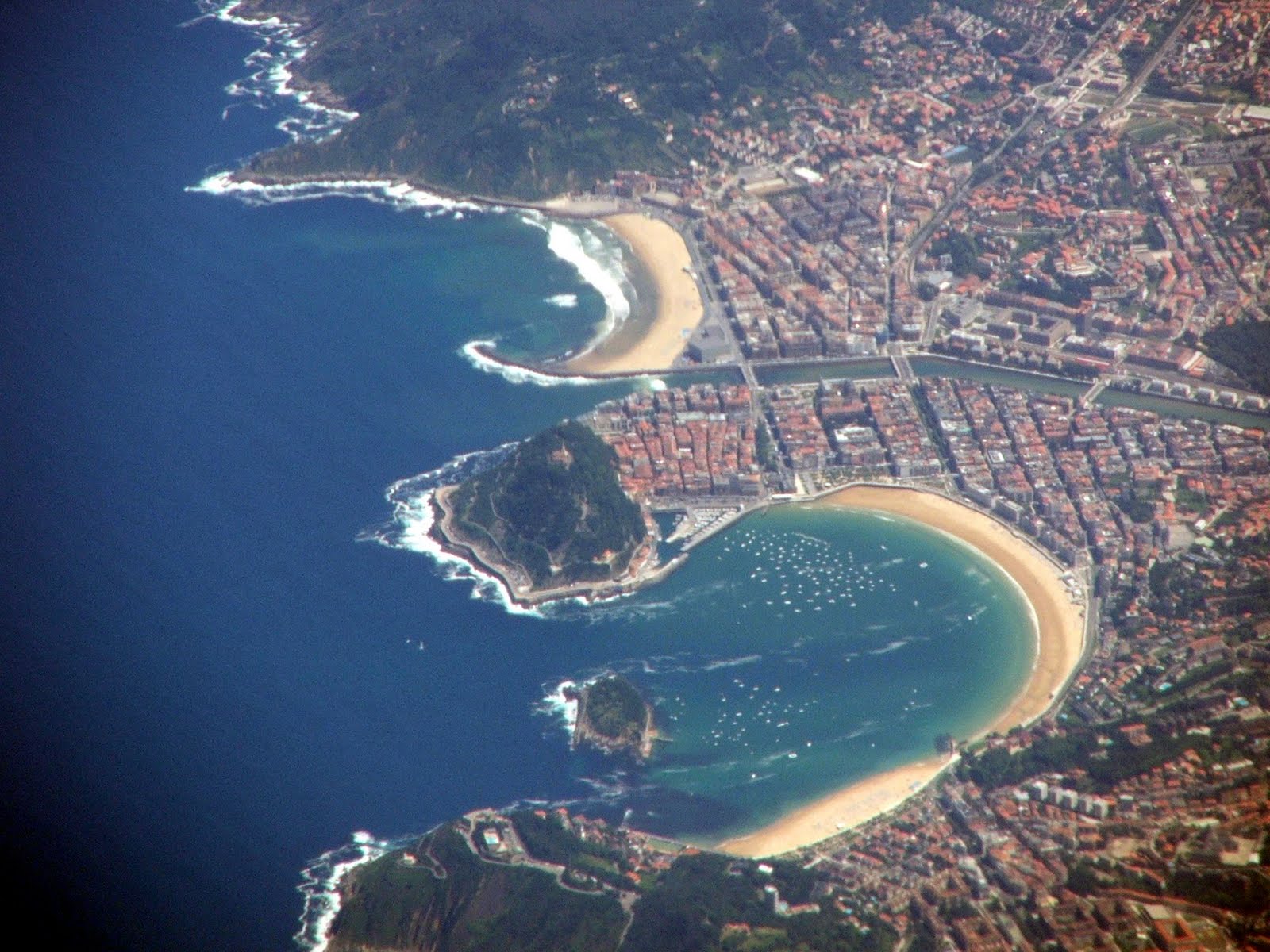
Overview of San Sebastian. The smaller bay shows the Zurriola beach, the bigger bay the Concha beach. The green hill in between them is Mount Urgull. At the south end of the Concha beach you see the Mount Igeldo, a view point you can reach with a little train. The old part is next to Mount Urgull. You can also see the river Urumea and several bridges. Photo
Wikipedia.
Note: The full correct name of this city is Donostia-San Sebastian, where Donostia is the Basque name.